Beyond WCAG: Why True Accessibility is About the Human Experience
Today we celebrate World Usability Day – the aim of which is “to ensure that the services and products important to life are easier to access and simpler to use”.
Download the audio version of this article.
Today we celebrate World Usability Day – the aim of which is “to ensure that the services and products important to life are easier to access and simpler to use”. This year’s theme, Emerging Technologies and the Human Experience, invites us to place people at the centre of design, ensuring technology evolves with empathy and inclusion. This is particularly important in digital accessibility, where innovation means little if people cannot access the content being created.
While the Web Content Accessibility Guidelines (WCAG) provide essential technical standards, they are only one part of accessibility. True accessibility requires a broader, human-centred approach grounded in empathy, usability, and inclusive design.
This article explores why it’s important to consider a holistic definition of digital accessibility, looking beyond WCAG conformance to understand its limitations and what else should be considered for truly inclusive design.
WCAG is a Starting Point, Not the End
WCAG remains the global benchmark for creating accessible digital experiences. The guidelines are measurable and practical and are an essential aspect of accessibility. However, WCAG addresses only part of the accessibility equation. Conformance to WCAG is vital, yet it is not the same as being fully accessible.
There are several examples of content that may be WCAG-conformant but still create barriers for people:
- A table with correct semantic markup that technically meets WCAG, but is overly complex with multiple rows and columns, making it difficult for many users to interpret.
- An image with a long or overly detailed text alternative that overwhelms rather than assists people using screen readers or other assistive technologies.
- A link label that is ambiguous or unclear for all users, not only for people with disability, meeting WCAG’s exception but still creating a poor user experience
- Colour contrast that meets the conformance ratio but uses bright neon tones that cause issues for people with photosensitivity.
Designing for the Human Experience
Accessibility is about understanding people with disabilities and how they use technology. It’s about understanding motivations, frustrations, and individual ways of perceiving and interacting with the world. This moves beyond the technical specifications of WCAG.
The concept of Human Inclusive Design is an approach to problem-solving that prioritises the needs, contexts, and experiences of the people who use a product or service throughout the design process. It involves understanding users through research, prototyping, and iteration to create solutions that are both effective and meaningful (See: Human Centred Design, Interaction Design Foundation).
More recently, the concept of empathy has expanded this definition. Empathy-centred design extends human-centred design by emphasising emotional understanding and building deep empathy for people’s lived experiences, challenges, and motivations to inform design decisions that are compassionate, inclusive, and contextually aware (See: What is Empathy and Why is it important in design thinking?, Interaction Design Foundation).
Incorporating Human Design
When we apply human-centred and empathy-based design principles to accessibility, we move beyond compliance toward experiences that genuinely work for people. Viewing accessibility through the lens of empathy and human-centred design helps define accessibility more holistically. It is about:
- Prioritising user testing as a matter of business as usual for all stages of development: Involving people with disability throughout research, testing, and decision-making, not just at the end.
- Interpreting WCAG and other accessibility guidelines through the lens of user experience and human centred design: Don’t aim for the merely ‘conformant’ solution but consider if there a better and more accessible solution.
- Considering intersectionality: how factors like language, culture, literacy, or socio-economic background affect digital experiences.
- Focusing on usability, not just technical conformance: because a design or product can conform to WCAG but still be confusing or unnecessarily increase cognitive workload.
When we prioritise human experience, accessibility becomes less about ticking boxes and more about creating the most accessible experience. As we’ve discussed, these more expansive design principles encourage us to:
- Recognise exclusion: Understand who might be left out by a design decision and why.
- Learn from diversity: Engage with a wide range of people to uncover needs and insights that lead to better solutions for everyone.
- Embrace ‘what is essential for one is good for many’: Innovations that start with accessibility often improve usability for all users (for example, captions benefit people in noisy environments and those learning a new language).
- Give people control: Allow flexibility, customisation, and choice, remembering the range of needs and preferences of users vary
Where WCAG might require us to provide a text alternative for images, human centred design may ask: Does the image itself add value? Does it communicate something essential to every type of user? Is there another more accessible way to present this information?
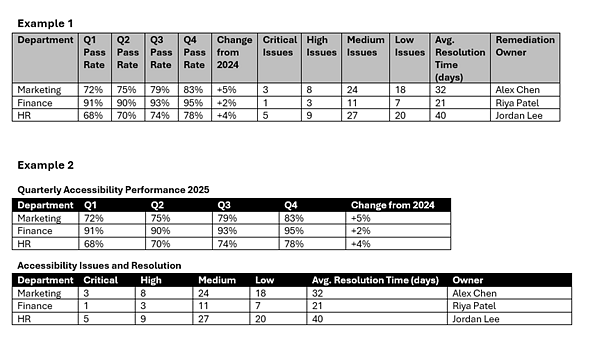
Inclusive design asks, “is a table the most inclusive way to present this information?” before the technical aspects of an accessible table are even considered.
Emerging Technologies
As artificial intelligence, virtual reality and voice-driven technologies develop, accessibility must evolve alongside them. These offer new opportunities for inclusion but also new risks of exclusion if human-centred principles are not applied from the start.
Technology often evolves faster than the guidelines that regulate it. Many WCAG success criteria do not yet contemplate new modes of interaction such as immersive or conversational interfaces. That’s why accessibility for emerging technologies must begin with empathy and inclusive design, not a process of retrofitted conformance.
The same principles that drive good design must extend into how we train, deploy, and govern these technologies. Accessibility in the age of emerging tech isn’t just about ensuring a product is conformant with WCAG; it is about ensuring people with disabilities can embrace these technological advances like everyone else.
Moving Beyond Conformance
When accessibility is framed only as conformance, it risks becoming a mere tick box exercise. When the focus moves away from merely ‘meeting’ technical standards to considering whether content is truly accessible, it creates better experiences for everyone.
As we celebrate World Usability Day, let’s remember to see accessibility as more than WCAG success criteria. Let’s treat it as a commitment to inclusive, human-centred design that keeps pace with technology and centres the user experience.